
A study by the Technical University of Munich with over 2,300 employees shows that an AI coach like Isa can measurably change behaviour - from exercise behaviour to productivity. The article explains how this works and why it also opens up new structural paths in OHM.
Workplace health promotion has long been part of good practice for many companies. However, despite the numerous programmes on offer, their impact and reach are often limited. Most measures only reach a fraction of the workforce, do not last long enough or fail to be transferred to everyday working life. Yet the need is obvious: lack of exercise, tension, concentration problems and an overall decline in well-being characterise the daily experience in many office jobs. But how can health-promoting behaviour be effectively and permanently integrated into everyday working life?
A recent study by the Technical University of Munich provides revealing results in this regard - and focuses on a hitherto little-used lever: artificial intelligence.
As part of a study involving over 2,300 employees from 50 companies, the impact that an AI-supported assistance system can have on health behaviour in the office was scientifically recorded for the first time. The study centred on Isa, a sensor-based coaching tool that accompanies office workers directly at the workplace over several weeks. The aim was to analyse whether and how factors such as ergonomic awareness, movement behaviour, drinking behaviour, subjective well-being and productivity change during use.
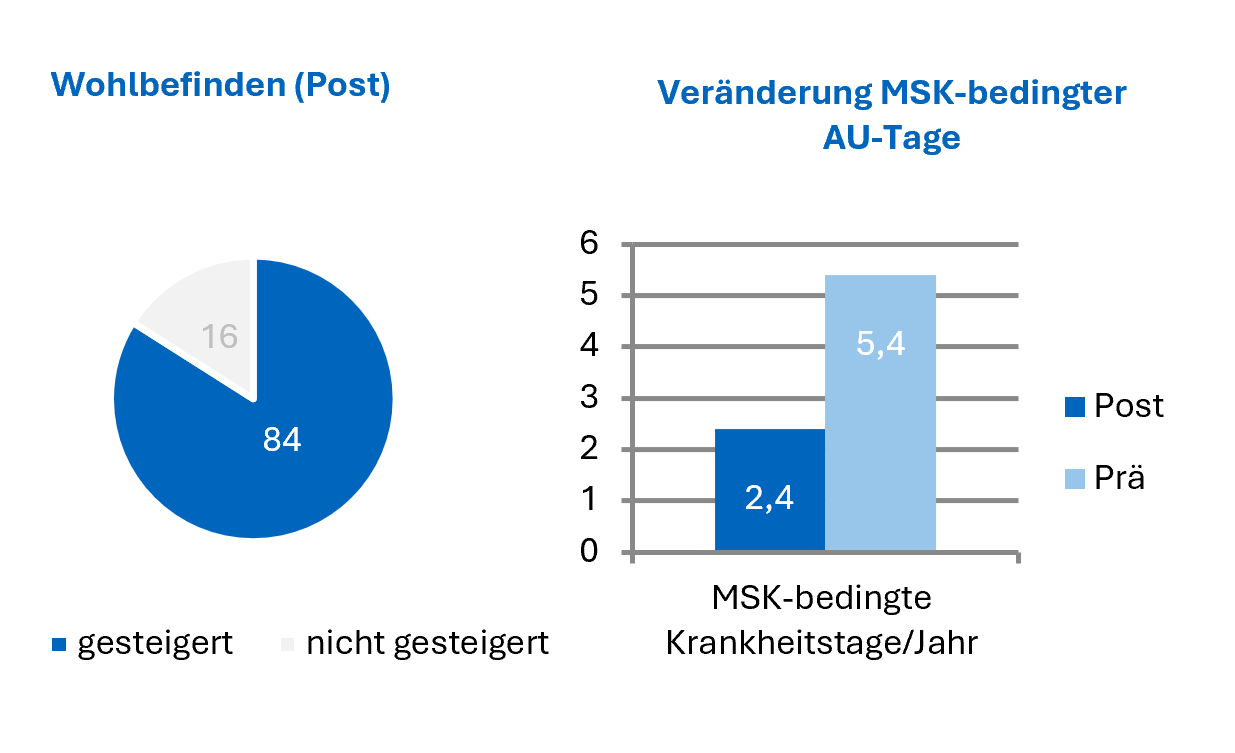
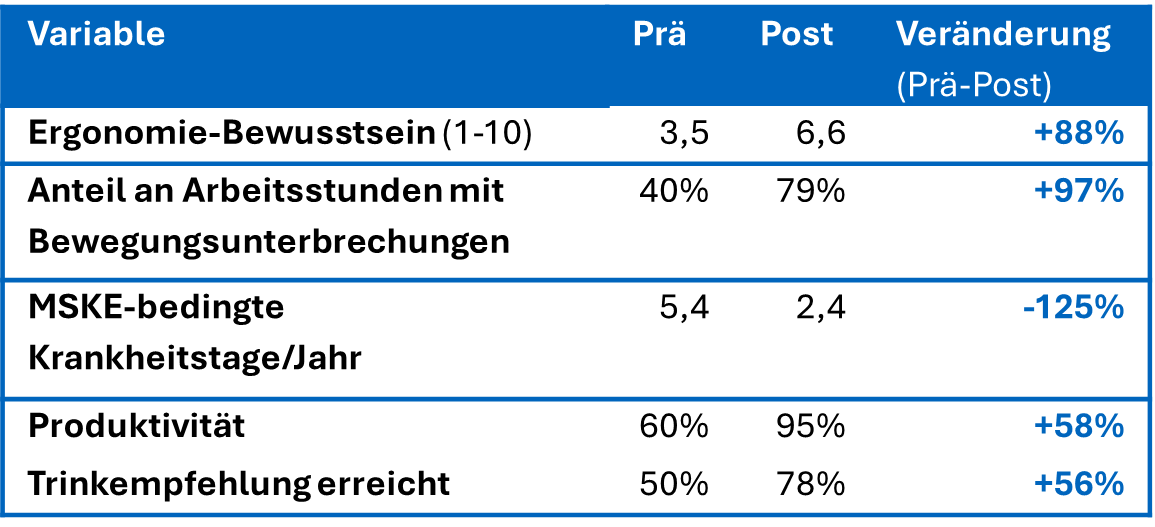
The results are clear:
Awareness of healthy sitting behaviour increased by 88 percent during the intervention phase. The number of interruptions to movement in everyday working life almost doubled. The effect was particularly evident in the number of sick days due to musculoskeletal complaints: These fell on average from 5.4 to 2.4 days per year - a reduction of 56 per cent. At the same time, the subjectively perceived productivity increased from 60 to 95 points (scale 1-100). Fluid intake also improved: while only 50 per cent of participants reached the recommended amount to drink at the beginning, this figure had risen to 78 per cent by the end of the programme.
Many reported that for the first time they had developed a concrete feeling for what healthy behaviour actually means in everyday working life - and how small adjustments have a noticeable effect on energy, concentration and mood.
The observed changes can be explained by proven models of behavioural psychology. The so-called COM-B model describes three necessary conditions for behaviour to change: People must be aware of the Capability to carry out a behaviour, they need to Opportunitiesto implement it in everyday life, and they must Motivation (Motivation) to actually do it.
Isa addresses all three levels: She imparts knowledge about posture, exercise and hydration, provides contextualised impulses for implementation and motivates through direct, individually formulated feedback at the right moment - without pressure, but with effect.
In addition, the Self-determination theory as a further explanatory model. It states that people are particularly motivated when they can make autonomous decisions, when they feel competent and when they feel involved. This is precisely where Isa comes in: it is not a monitoring tool, but a personal assistant that supports rather than patronises. Progress is reflected in an appreciative manner and decisions always remain with the users themselves. This creates a health-related sense of self-efficacy - a key factor for long-term behavioural change.
What also makes Isa special is not just the Psychological effectivenessbut also the Structural simplicity in the corporate context. The system was designed so that it works without any additional work for the BGM team. Employees can order Isa "on demand" for several weeks via a company-specific booking portal. No devices need to be purchased; use is limited to around twelve weeks - a period that is usually sufficient for sustainable behavioural change. This is also confirmed by the feedback from thousands of users who have already used Isa through their employer: Around 80 per cent state that they maintain healthy behaviour patterns in whole or in part beyond the period of use.
Isa is therefore not to be understood as a one-off measure, but as a Entry into a continuous process of workplace health promotion. In contrast to traditional individual campaigns, Isa specifically addresses the vast majority of employees - regardless of their individual health affinity or previous digital experience. Thanks to its low-threshold access, intuitive use and everyday impact, Isa achieves participation rates of up to 80 per cent - a figure that is rarely achieved in traditional BGF measures. This not only changes individual behaviour, but also the corporate health culture in the long term. Initial reports also show measurable effects on relevant company key figures, such as reduced absenteeism and increased productivity.
Deep Care takes over all organisational processesShipping, onboarding, support, return and maintenance of the devices as well as the accompanying evaluation. At the same time, a data protection-compliant BGM dashboard aggregated and anonymised insights, which companies can use to track effectiveness and make strategic deductions - without gaining insight into personal data. The individual behavioural data remains exclusively locally on the respective device and is never transferred to a cloud.
The result is a measure that can be integrated directly and seamlessly into existing work processes - without new software, without the need for training and without additional work for the OHM team. It is precisely this low-threshold structure combined with high effectiveness that makes Isa a sustainable tool for holistic workplace health promotion.
The results of the TUM study impressively show that artificial intelligence can do more than just analyse or provide information. Used correctly, it can influence behaviour, improve health and help to transfer prevention from theory into practice. The decisive factor here is a design that is orientated towards people - their everyday lives, their needs, their scope for decision-making.
Isa thus exemplifies a new generation of health services in the workplace: individual instead of generalised, behavioural instead of theoretical, continuous instead of selective. The combination of technological innovation, a basis in behavioural science and practical feasibility in everyday company life marks a possible turning point in occupational health management - away from individual actions and towards effective, sustainable health promotion in everyday working life.
Yes, Isa is already being used in over 200 companies - including large corporations such as DB, Bosch and E.ON as well as public organisations such as the German Pension Insurance or the German Armed Forces. Isa is also part of health programmes offered by other service providers such as BG prevent (formerly B-A-D GmbH) or Team Gesundheit.
Yes, Isa is certified in accordance with § 20 SGB V and is supported by many health insurance companies. In addition to the Techniker Krankenkasse (TK) and the AOK, there are co-operations with numerous other GKVs and BKKs. In many cases, the insurance companies cover part or even all of the costs.
The organisational effort is minimal. As a rule, we start with a four-week pilot phaseThe results of this usually provide a good basis for decisions on how to proceed. We recommend involving the works council and relevant decision-makers as early as this phase. After a successful pilot and the approval of the decision-makers, the only remaining effort is the Internal communication of the offer - We provide ready-to-use materials for this purpose.
Everything else is automated: Employees order Isa via a company-specific booking portal, receive the device directly from us and return it after the usage phase. Optionally and anonymously, a Questionnaire on effectiveness can be filled out digitally. The results are continuously analysed and are available in the Live dashboard available.
Data protection is a top priority at Isa. All usage data is only stored locally on the device - There is no cloud storage and no personalised tracking. Isa completely dispenses with a camera and instead uses a 3D sensor that does not allow people to be recognised. The accompanying BGM dashboard only shows Aggregated and anonymised data. In previous projects, the use of Isa consistently rated positively by works councilsin particular due to the high data protection standard and the voluntary nature of use.
Yes, access is usually via a Non-binding pilot phase. It offers the opportunity to familiarise yourself with the impact and acceptance in your own company - without any long-term commitment.
It not only helps you to make the decision to introduce Isa in your company, but also helps you to convince other decision-makers in the company that it makes sense.
You are currently viewing a placeholder content from Facebook. To access the actual content, click the button below. Please note that doing so will share data with third-party providers.
More Information